I have a post up on Monetary Metals commenting on Jeffrey Snider's observation of the anomalous situation in the gold market between 2013 and 2016 where negative gold forward rates (GOFO) indicated backwardation while the gold price was falling. I expand on Jeffery’s chart which shows periods where the LBMA GOFO rate was below zero, along with the Bank of England’s custody holdings (gold held on behalf of central banks and bullion banks) with Monetary Metal's MM GOFO figures. Read more here.
I also addressed comments on the article at Zero Hedge and Silver Stackers.
Showing posts with label Backwardation. Show all posts
Showing posts with label Backwardation. Show all posts


05 October 2015
Sucking silver through a straw
On Friday there was a big move in precious metals, with gold up $25 to around $1135 and silver up $0.70 to around $15.20. In percentage terms the silver move was much more dramatic, approximately 4.8% compared to gold’s 2.3%. The move was in reaction to US non-farm payroll numbers, but in this recent post, Keith Weiner at Monetary Metals goes behind the headline grabbing move and looks a little deeper into what it tells us about scarcity in the silver market. [read more]
03 December 2014
Gold lease rate curve inversion
Following on from Monday's post on this unhistoric GOFO, I've got around my problems with image upload on blogger by putting it up on twitter first.
Below is the 1 month and 12 month lease rates back to 1998. I think it is pretty clear that this current situation, while trending in the direction of something historic, is not there yet.
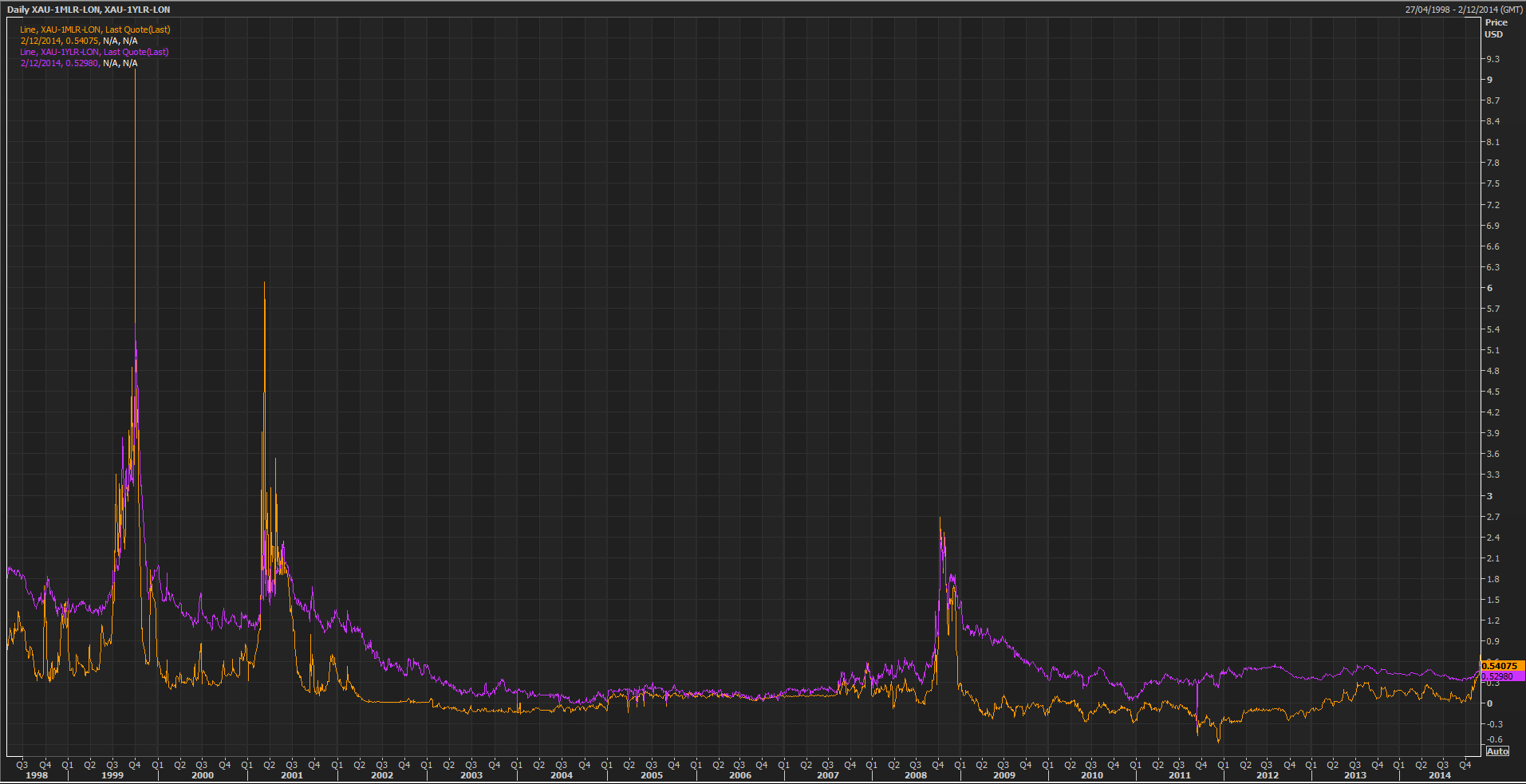
What is interesting is that the gold lease (interest) rate curve has just started to invert, with 1 month rates at 0.54075% while 12 month is at 0.52980%. Such inversions are rare, with the significant occurrences being in 2008, 2001 and 1999.
It is worth noting that during these periods the lease rate spikes lasted for at least 3 months before returning to pre-spike normal lease rates. There is also no correlation with action in the gold price. In 2008 for example, the gold price continued to weaken as lease rates went up during early Q4 2008. In 1999 you can see that the gold price was stable during Q3 1999 all the while lease rate spiked to record highs. So I think it is premature of commentators to spin this high lease rate/negative GOFO as guaranteed indicator of a bottom - history shows that price could weaken further before climbing.
On Monday I gave a number of reasons why we are seeing the action we do. The 2008 experience where the price fell while lease rate were high does suggest shorting. I would note that such shorting action could come from futures markets where speculators see the initial price weakness and then pile in. In such one-sided situations bullion banks will make a market and take the long side and hedge themselves by shorting gold in the OTC spot market. Such shorting activity will result in demand for borrowed gold, hence lease rate rise.
Such a theory means that lease rate spikes (if speculative driven, not liquidity driven) may be indicative of excessive shorting and thus market bottoms. If one saw futures speculative positioning on the short side, bullion banks on the long side and high levels of open interest at the same time as lease rates spiking off recent normal levels, then that could provide strong confirmation of excessive short sentiment.
By the way, Steven Saville has also just blogged on the recent "backwardation", saying much the same as I did on Monday but his post has GOFO and LIBOR charts which show the identical behaviour - worth checking out to see what I was going on about.
01 December 2014
How historic is this negative GOFO?
So is this occurrence of negative GOFO a "Gold Shortage, Worst In 21st Century" as Zero Hedge recently claimed?
Keith Weiner notes that by his strict definition of backwardation (a positive cobasis) there are now four futures contacts in backwardation when "prior to this, the most we’ve seen is three". He considers this serious and suspects "that this time, it’s a matter of price. We believe that when the price rises enough, this backwardation will subside".
JP Koning has an interesting take, suggesting that negative GOFO is revealing the market's "convenience yield", a price businesses in the trade are willing to pay for "uncertainty-shielding services". As he explains:
"Gold merchants seem to be anticipating choppiness in the future supply and demand of the metal, and see growing benefits in holding inventories of the stuff in order to cope with this choppiness. The convenience yield on these inventories has jumped to a high enough level that it currently outweighs the costs of storing and financing gold, resulting in an inverted gold market."
In contrast to Keith, JP notes that gold forward prices are only inverted "over a narrow range of five or six-months. By mid-2015, forward prices return to their regular pattern of trading at a premium to current prices ... So no, gold is not becoming money. Rather, we are running into some short-term jitters, and merchants think that holding the stuff provides a few more ancillary benefits than before".
The more interesting part of JP's post for me, which leads us to an answer to my question, is his observation that "earlier disruptions occurred when U.S. interest rates were already high enough that they continued to outweigh the metal's suddenly-augmented convenience yield. ... Going forward, all gold market disruptions could very well create sharp inversions of -1 to -2% in the 1 to 12-month horizons, insofar as we are living in an era of permanently low interest rates".
To explain JP's point, have a look at this chart from his post below. 
Note the unusual chart pattern where GOFO moves up in a straight line from 2004 to mid-2006, is then flat for a year and a bit and then drops sharply over the next year and a half. I wonder what was going on in the gold market during that time to account for that behaviour?
For the answer go to http://www.lbma.org.uk/pricing-and-statistics and select LIBOR in the chart drop down box. Isn't that amazing, US interest rates during 2004-2008 exhibit exactly the same chart pattern as GOFO.
In actual fact, there was nothing going on in the gold market. GOFO is mathematically equal to US Interest Rate minus Gold Interest Rate. Thus if US interest rates go up and Gold's Interest Rate is stable, then GOFO will rise. If you select "LIBOR minus GOFO" (ie, Gold's Interest Rate) in the LBMA's chart, you will see that it was indeed flat during 2004-2008.
If you look at that "LIBOR minus GOFO" chart you will see that while the interest rate on gold has moved up, it is not "historic", for which we would need to see interest rates above 2% (which at ZIRP would equate to circa -2% GOFO). The only reason current GOFO rates look historic is because cash rates are basically zero. Comparing GOFOs over time is not really comparing apples to apples - the only way to look through the effects of ZIRP is to look at gold's interest rate. It is like looking at cash interest rates during the 70s and 80s and noting how much better depositors were off compared to today because bank deposit rates were 15%, and completely ignoring the differing inflation rates between now and then.
This then leads on to the question of why would lease rates be rising (or it could be GOFO falling, it is hard to tell which market is in the driving seat sometimes)? I've said this a few times, but there are only two things you can do with borrowed gold:
For the second reason, sell it, this basically means that people are shorting gold. It could be speculators, or maybe miners have resorted to hedging again (I note there was a 55 tonne increase in the global hedge book in Q2 2014). Consider that when miners stopped hedging and started to reduce their hedges in 2002 that gold interest rates crashed to their current low levels.
So while Zero Hedge may spin a falling GOFO as bullish, it could be indicative of a rising interest rate on gold, which could be an indicator of short selling/hedging, which would result in a falling gold price. And what has gold been doing recently? I'm not saying this is the explanation, mostly likely all the explanations mentioned in the last two paragraphs are in play, we just don't know which is the main driver at this time, but at least here you will get some of the negative explanations to weigh up.
- hold it
- sell it
05 February 2014
The gold lease rate is not an interest rate
Keith Weiner, president of the Gold Standard Institute USA, has the second post in a series responding to Tom Fischer's "Why gold's contango suggests central bank interference" which I blogged on here.
The post focuses on the gold lease rate and Keith starts off by saying that "to answer the question of how the gold interest rate is established today, we must look at who the actors are and the mechanics of what they do."
When looking at the actors using gold leasing he notes that "gold is not borrowed to finance purchase of long-term assets" but is only used by "businesses that specialize in gold, such as refiners, mints, and jewelers ... to enable them to carry inventory or hedge inventory" (such as the Perth Mint, which Keith notes is the only other business apart from his own fund business that keeps their accounting books in gold).
However, he concludes that gold specialists use of gold is "similar in some ways to Real Bills ... used to finance inventory that is moving predictably towards the consumer" and thus that the "gold “lease rate” is conceptually closer to the discount rate of Real Bills than the interest rate of bonds" because the gold lease rate "does not emerge from the actions of either savers or entrepreneurs. Nor does it arise from the actions of the consumer and the retail industry in general".
I think this way of looking at the gold lease rate is valuable to understanding the rate and thus GOFO and backwardation and what is may mean.
PS, I was encouraged to see Keith's article get picked up by a number of sites, like ZH, Gold Seek, Safe Haven, FSN and Acting Man, for what is content that is more intellectual and technical, rather than the usual gold to the moon type tabloid stuff.
28 October 2013
Why gold's contango suggests central bank interference
In Faux Gold Arbitrage I mentioned that Tom makes the case that if anything, backwardation should be the normal state for gold. His paper arguing that case is in the clear on his site here and was also noted by GATA here.
Tom's argument is that backwardation, and not contango, should be the natural state for gold and thus the fact that gold has been in contango for "essentially all of the last 25 years strongly suggests central bank interference with the gold market." It is a counterfactual, trying to guess at how gold would behave relative to fiat if there was no manipulation.
It contrasts with those who focus on the short history of gold in the post gold standard world and observe that gold backwardation is rare, like James Turk in this piece for GoldMoney where he notes that "Gold backwardation is an abnormal condition" and "has only happened two times since this bull market in gold began back in 1999, and each prior occurrence lasted only a few days." Tom's article basically says that just because it is rare, doesn't mean it is abnormal.
James' view is based on the assumption that "interest rates are a reflection of risk" and that a currency "has a higher interest rate because it is more likely to be debased by government and central bank policy (i.e., lose purchasing power)". I think this is only looking at the supply side of the equation, and ignores demand for borrowing money. So for an economy with poor prospects there may be little demand to borrow and interest rates can fall even though no fiat is being printed.
James then says that "interest rates today result from heavy-handed central bank manipulations, thwarting real and accurate price discovery by the market" and that "market forces overpowering central bank manipulation can explain what is now happening in gold". But Toms says if contango has existed while markets have been manipulated and backwardation occurs when market forces overpower, then logically isn't backwardation the natural state for gold?
Tom makes a number of other points (including the point that money is often in backwardation, see my post on that here) and I recommend reading his paper as it will get you to think more deeply about gold, its monetary nature, and what backwardation really means.
19 September 2013
Faux Gold Arbitrage
This is another post on backwardation, fourth in a row. Maybe I need to change this blog to www.backwardationchat.blogspot.com.
Anyway, I have been corresponding with Professor Tom Fischer of the University of Wuerzburg on backwardation and I've been remiss in not drawing my readers' attention to his Faux Gold Arbitrage article which was published by Bullion Vault on Sep 3rd or available from Tom's website as a pdf here.
Tom's article addresses the claim that backwardation is abnormal as it is profit that is not being arbitraged away and he picks up on the interest rate differential point I made in my 2008 "Gold isn't in backwardation, the USD is in contango" post.
An important point he makes is that arbitrage is "an investment that outperforms the risk-free rate of return in that currency ... “making money out of nothing”, or a “free lunch”, as we could borrow money if we do not have any, then outperform the loan's interest (the risk-free rate) by ways of the arbitrage strategy, and finally pay back the loan while keeping the profits over the risk-free return."
He goes on to note that if an investor had to first borrow gold to run the arbitrage, then at the end of the period the amount earned from selling gold at spot and buying the cheaper future would just equal the interest rate on the gold loan. Therefore no profit and thus no arbitrage.
Because gold is monetary (and not a commodity) and has an interest rate, OTC forwards and futures markets just reflect the interest rate differential between the two currencies USD and XAU. From this viewpoint, gold futures markets are just synthetic gold borrow/lend markets. Consider these simplified flows involved in a backwardation "trade" for someone with gold using Tom's numbers:
Start of trade:
Start of trade:
- Sell gold: -1000oz
- Receive cash: +$1,500,00
- Buy future (ignoring margin for simplicity) @ $1,470
- Put cash on deposit @ 1%: -$1,500,000
End of trade:
- Recall deposit with interest: +$1,515,000
- Pay cash for future: -$1,470,000
- Receive gold from future: +1,000oz
Consider these flows for a gold loan:
Start of loan:
- Loan gold @ 3% based on $1,500 price: -1000oz
End of loan:
- Gold loan repaid: +1,000oz
- Receive interest on loan: $45,000
Compare the net flows between the two:
| Date | Backwardation Trade | Gold Loan |
| Start | -1,000oz | -1,000oz |
| End | +1,000oz | +1,000oz |
| End | +$45,000 | +$45,000 |
Backwardation (or contango) in a futures markets for currencies like gold is not an arbitrage trade, it is just a lend (for a backwardation or decarry trade) or borrow (for a contango or carry trade). Futures market prices just tell us what market participants think is the appropriate interest rate to receive or pay for a gold loan.
That interest rate is interesting and tells us something about the views of market participants, especially with respect to US dollars. But there is nothing right or wrong/abnormal about the fact that gold interest rates may be higher than USD interest rates, just like there isn't anything normal or abnormal about the fact that AUD interest rates are currently higher than USD interest rates.
PS - in emails Tom makes the case that if anything, backwardation should be the normal state for gold. But that is for another post.
14 August 2013
PM Bug forum comments on backwardation
Those who are not bored to death with the backwardation/gold bank run narrative may find my comments on this PM Bug forum thread of interest, which was in response to this post of mine. I've cut and past some of them below for the lazy readers, but to get the correct context of Mr/Ms Unbeatable's probing questions you need to read the thread. I'm working on some posts on GOFO/backwardation to further expand on my comments in this post.
Originally Posted by Unbeatable:
| Hmm.... When he sees 400oz bars attracting a 'special premium' he will let us know?The two biggest gold consumers India & China are paying a $30+ premium an ounce over spot, a 600%+ increase over what they paid in previous years!? |
Originally Posted by Unbeatable:
| Hmm... When he sees bullion banks desperately bidding on Perth Mint's refining output he'll let us know? |
Originally Posted by Unbeatable:
| Hmm.. When he sees restrictions on how much gold can be bough he will let us know? 'the Reserve Bank of India banned import of gold by domestic consumers through bank credit' ' Gold coin and bar sales stopped in India' 'Pakistan temporarily bans gold imports' |
Originally Posted by Unbeatable:
| But to be blunt (And as I think you know full well yourself), the idea that you'll see the overt stress indicators that you suggest coming from the bullion banks actions themselves is quite frankly absurd because the day they show provable supply side issues is the day they default. |
Originally Posted by Unbeatable:
| Which is why I showed how each of the indicators are already clearly manifesting themselves in the gold market. (& though you repeatedly try to pretend that there is this massive separation between stresses in demand in the retail and wholesale market, they are in fact completely interlinked.) |
The indicators you mention are just indicators of strong end user demand, not a run on the bullion banks nor any stress at that end. India premiums reflect the restrictions the Govt has put on, something they have been ratching up for a long time well before this talk of a run/stress and driven by a CAD problem. It hasn't affect demand much at all - instead of the shipments of gold we sell going to India they have suddenly started going (demand coming from) dubai and thailand, funny that.
Originally Posted by Unbeatable:
| 1. In times of demand stress the bullion banks are the ones supplying many mints with additional refining input never mind bidding on the output? |
Originally Posted by Unbeatable:
| 2. I'd imagine the bullion banks have preferential contracts in place and ones that prohibit you, a Perth Mint employee from disclosing market sensitive information, so I take your 'I will let you know' with a pinch of salt. |
Originally Posted by Unbeatable:
| 3. If the bullion banks were having issues, instead of people like Perth Mint employees letting the public know about it, I'd expect them to go out and try to convince people of the opposite - 'Don't worry there are not wholesale supply issues' & shi*, look, here you are... |
Originally Posted by Unbeatable:
| So rather if I was looking for supply problems in the 400oz wholesale market, I'd look for signs of additional central bank leasing, particularly the Bank of England who are a key source of supply in times of stress. & shi* look a story just in the last two weeks that the BOE may have leased up to 1300 tons in the 400oz wholesale market in the first half of the year |
The 1300t story is another beat up, see here http://www.screwtapefiles.blogspot.c...or-layout.html the BoE said that the figure that Alasdair relies on for his whole thesis cannot be relied upon.
Originally Posted by Unbeatable:
| Or I'd look for signs that Bullion Banks are running short of supply and/or are being forced to help one another out. & shi* look at how much of JPM's inventory has been removed this year and also this story from just yesterday |
Originally Posted by Unbeatable:
| But as these don't constitute hard evidence, & people like Potemkin would say 'Rumours, words, stories...' I chose to bring up provable supply side shortages &/or unprecedented demand in the gold market which is of course what creates the wholesale market problems you are witnessing above. |
Originally Posted by Unbeatable:
| Really!? How many hours do you think it will take from the time they announce purchasing restrictions to Gold Money to the time they default? I think you know that this is the very last thing they will do, if they don't actually just default first. |
Originally Posted by Unbeatable:
| If there are demand stresses for gold, I think it's (painfully) obvious that they would rather do their best to try cut demand from the biggest gold consumer, India. (EDIT: Which is obviously why I brought up the restrictions in India and outright temporary import ban in Pakistan as being very indicative of shortages in the wholesale market.) As this would ideally (For the bullion banks) have the effect of decreasing demand for their good delivery bars in that market and also freeing up mint output sourced from the mines & scrap, so that it could then be used to refine new 400oz delivery bars for the bullion banks as opposed to coins and smaller bars for retail. |
Originally Posted by PMBug:
| Bronsucheki, are you able to confirm or deny this claim (at least as it pertains to the Perth Mint) from Bill Haynes? |
Originally Posted by Unbeatable:
| Hi Bronsucheki, thanks for taking the time to give such a detailed response and for doing it in a pretty reasonable tone despite how confrontational mine was. Also especially considering that you work & have considerable knowledge in that area vs. me who doesn't. |
In addition, we did hear that 99.99% purity 400oz bars were attracting a premium in London (but the normal 99.5% purity wasn't). Mostly likely explanation for that was that 99.99% purity 400oz bars could just be melted and recast into kilo bars (which are generally preferred to be 99.99% purity in Asia/India) without needing refining. Screwtapefiles blog did some good analysis on the number of 99.99% vs 99.50% purity and what was being withdrawn from GLD, but nothing conclusive yet.
So certainly this is all very unusual and you're right to be cautious.
Originally Posted by Unbeatable:
| So I'm surprised during the period of unprecedented demand this year that you didn't have to source any additional supply from the LBMA in London again? |
Originally Posted by Unbeatable:
| You also say the majority of your non coin production is being made into Kilo bars for the highest bullion bank bidder. But I was under the impression that the bullion banks dealt in the larger 100 & 400oz bars & that the 1 kilo bars would be more for the retail investment market? |
Originally Posted by Unbeatable:
| But the import taxes/duties in India are 8% that would be $104 an ounce, far higher than the $30 premium the media is using. Doesn't this mean that the $30 premium is the premium they're paying prior to import duties/taxes being applied? |
Originally Posted by Unbeatable:
| this is perhaps the first time we have seen this happen laterally between two vaults |
Originally Posted by Unbeatable:
| Today I see another negligible 4k ounces went from Scotia to JPM and JPM converted a massive 70k ounces from there 360k registered total and moved it onto their 100k eligible total. |
Originally Posted by Unbeatable:
| Personally I think at the very least a Bullion Bank run is in progress at JPM and I think even though the writing is on the wall, the others are just trying to help JPM make it to some pre-determined end date. |
Originally Posted by Unbeatable:
| My question to you is, having seen how these unusual transfers have continued since my original post do you still think |
Originally Posted by Unbeatable:
| My question to you is would you agree that the banning of buying gold on consignment did have the effect of considerably decreasing India's overall physical gold demand for 1-2 months (incl. smuggling)? |
I disagree with Eric Sprott that western central bankers "called up" India and asked/told them to do these import restrictions to help them out. I agree more with Jim Rogers on this "Indian politicians who suddenly blamed their problems on gold. The three largest imports to India are crude oil, gold and cooking oil. Since they can’t do anything about crude and vegetable oil, the politicians said India’s problems were because of gold, which, in my view, is totally outrageous. But like all politicians across the world, the Indians too needed a scapegoat."
26 July 2013
Norcini: Gold is not in backwardation
In my last post I was not saying that what we see now on COMEX and with GOFO is not important – remember the mugger in Crocodile Dundee still had a knife – just that his switchblade is small compared to Dundee’s much larger “full” backwardation knife.
There is a lot of confusion about the definition of backwardation. Here is a quote from the Dummies series of books:
"When a market is experiencing backwardation, the contracts for future months are decreasing in value relative to the current and most recent months. The spot price is thus greater than the front month, which is greater than future delivery months."
Note their use of plural – "contracts" and "futures months" - as these other links also do, from the first page of a google search on "definition backwardation":
Wikipedia - "The resulting futures or forward curve would typically be downward sloping (i.e. "inverted"), since contracts for further dates would typically trade at even lower prices."
McClellan Oscillator - "Backwardation means that forward contracts are priced lower than nearer term contracts, or spot"
Investopedia - "Backwardation is the same as inverted when futures prices are lower than spot prices."
This is what I understand by backwardation when one uses that word in a general sense about a futures market. Having said that, I think it is valid to talk of a specific month being “in backwardation” even if that is not exactly a precise use of the term. What I have a problem with is describing what we are currently seeing in gold as a general backwardation and playing this up as a sign of the failure of the fractional reserve bullion banking system. It is not.
Last word on this I'll give to Dan Norcini:
"gold is not in backwardation and has not been at any time whatsoever on the Comex during the entire time this backwardation talk commenced and picked up some gullible followers"
The post is worth reading in full because he explains the need to look at current bid/ask rather than last price for the further out contracts due to lack of liquidity and the difference between backwardation and the basis (or strong basis as he calls it when spot is above futures). He also makes the following statement:
"When we do however see a STRONG BASIS PLUS a BACKWARDATION STRUCTURE ON THE FUTURES BOARD, then we have the real deal."
I covered similar ground this in 2010 post, saying that that occasional "backwardation" in the shorter months is just the start, or first sign, of a breakdown in the system. Calling what we see now in gold as backwardation proper overstates the phase we are in.
I think the other issue with backwardation is that it is a concept that comes from commodity markets. In this post I question whether such a commodity type interpretation of backwardation is appropriate for gold. Aren't we told that gold is a monetary asset with high stocks to flow, unlike commodities? If so, should we apply a commodity futures market interpretation to gold? As I say in that post "Then you see that gold hasn't went into backwardation, but that USD has went into contango."
If gold is mostly monetary with only a little commodity-like nature, it is therefore best analysed as a currency and in that respect, no one talks of currencies going into backwardation or contango, they just have different interest rates and that differential might drive a carry trade if the difference is big enough. FT Alphaville has done a whole series on this more "financialised" view of gold.
Regarding negative GOFO (which reflects the interest rate differential between USD and XAU), my current view is that it is reflecting the shift by speculators to the short side - more shorting results in more demand to lease gold, which drives up the lease rate (thus GOFO goes down). I have read that liquidation by specs out of long positions has also restricted supply of gold to lease (as the gold has been sold to those unable or unwilling to lease their gold out) and seen comments that increased physical demand has resulted in more metal being tied up in the value chain, so that results in more demand for leasing (or inventory to hedge).
So I think there is a case to say that negative GOFO as more driven by tightness in the gold leasing market. Note that shortage in the borrowing and lending market does not have to coincide with a shortage in the buying and selling market. Holders of gold may be willing to sell it (so price is low), but at the same time those continuing holding it (or the new people buying it) may not willing to lend it (so lease rate is high).
This is why it is logical for Dan Norcini to say that the structure of the futures market is not exhibiting "a true supply shortage" while at the same time we have negative GOFO and some futures contracts below spot.
So this development in leasing is probably what has driven GOFO negative, which, as Keith Weiner notes in this post, is then synced/transmitted to the futures markets by arbitrage (and has a very compelling combined chart of GOFO and the basis to prove his point). Therefore I think we are currently seeing is more a liquidity squeeze on the bullion banks, rather than a full blown distrust in them by holders of unallocated or shortages of physical (a price squeeze).
A real gold bank run will manifest itself in the wholesale markets for 400oz bars. When I see them attracting a premium and/or being difficult to source, or bullion banks desperately bidding on the Perth Mint's refining output, then we "have the real deal" as Dan says. I will let you know.
Alternatively, just watch Bullion Vault and Gold Money - which are backed by 400oz bars and which deal in that market every day - for reports of difficultlies in getting 400oz bars and restrictions on how much gold can be bought, and/or if they start to add on a "special" premium to their spot price.
Don't be complacent however. What I'm talking about above is the end of the line and things can unravel quickly - a liquidity squeeze can turn into a price squeeze - so keep your gold close or stored with non-banks, like the Perth Mint, who don't engage in fractional reserve and maturity transformation activities.
Don't be complacent however. What I'm talking about above is the end of the line and things can unravel quickly - a liquidity squeeze can turn into a price squeeze - so keep your gold close or stored with non-banks, like the Perth Mint, who don't engage in fractional reserve and maturity transformation activities.
24 July 2013
Shortodile Golddee: That's not backwardation
Shortodile Golddee is threatened by a goldbug with backwardation

Sue Shortton: Shortodile Golddee, give him your short positions.
Shortodile Golddee: What for?
Sue Shortton: He's got backwardation.
Shortodile Golddee: [chuckling] That's not backwardation. [draws a oil chart] That's backwardation.

(apologies to the screenwriters and thanks to Nick for the charts)
13 January 2012
Emotions, Premiums and Backwardation
Good interview between Jeff Lewis (silver-coin-investor.com) and Grant Williams (vulpesinvest.com). Grant makes a very good point on emotions influencing how events are interpreted (my emphasis):
" It’s important to try and keep a sense of balance because the way things trade, particularly in silver, it’s easy to get fixated upon an idea and to blame every move on that particular idea. In the case of silver, the big theory about silver is the manipulation of the COMEX futures. ... It’s a dangerous game to sort of ascribe every single move in an instrument to a construct that has yet to be proven beyond any doubt. While I suspect there is definitely something untoward going on the silver futures as Bart Chilton has intimated in his comments this past year. I think it’s a very dangerous game to not have a balance, to just simply look at the way markets behave, look at the extraneous events that may have an effect and cause the de-leveraging or liquidation and to try and get a more rounded picture of why something moves now."
Later he says what the extraneous event was:
"I think a lot of that downdraft we saw in both gold and silver going into year end, was just people who are having to raise cash and selling the thing that they had a little bit of profit built into. Now, once they start going down, the shorts are going to press that; and so these falls get a lot more vicious than perhaps they would be in just an orderly market where people were looking to sell a bit of precious metals to raise some cash for year end. But as I say, you have to try and take your emotions out of this thing."
Interesting here that Grant says that the initiator of the price drop was year end selling, which was further "pressed" by speculators. I made a similar point in this corporate post when talking about bullion banks being aware of falling Indian consumer demand. My point, and Grant's, is that not everything is a manipulation (as in being initiated by speculators) and sometimes speculators are just riding a physical market trend. Don't drink the Kool-Aid (or should that be "Silver-Aid") of the pumpers which blame every price drop on manipulation but who never question any price rise.
As Ted Butler says (my emphasis) "... when silver experienced two separate 35% price declines in a matter of days. Such a decline in a world commodity for no observable supply/demand reason is unprecedented and I would say impossible in a free market." Same applies when you have the London AM Silver Fix increasing 20.1% over 24 hours from $10.77 to $12.93 on 18 Sep 08 (note: I can't find two 35% price declines in London Fix data, Ted must be talking intra-day).
Some who has been drinking the Silver-Aid is Tyler Durden with the silly headline Physical Silver Surges To Record 30% Premium Over Spot, In Backwardation. Regrettably, it was picked up by Money Morning Australia (from whom I'd expect better), to which I left this comment:
"What that chart tells us is that PSLV is a closed end fund with some possible tax advantages with good marketing, hence the premium. In the real physical wholesale silver market which is not constrained by a limited number of shares, Perth Mint is not having any problem acquiring, or selling, silver at spot."
Tyler must be drinking a lot of Silver-Aid or desperate to alleviate the cognitive dissonance of a circa 25% increase in COMEX silver warehouse stocks since mid-2011 to claim that a stock exchange listed trust is as good as and representative of cold hard physical in your hand.
Further proof that Tyler is suffering is his conclusion that the backwardation discussed in Keith Weiner's appended article "means, although for those who like the punchline here it is, as above: shortage" when, if you read Keith's good article, he says at the bottom that (my emphasis) "In a normal commodity, backwardation means shortage. ... But in gold and silver it means something else entirely. People have the metal. But for whatever reason(s), they choose not to take this free money. In the silver market right now, trust is in short supply."
Why everyone thinks that Zero Hedge is a credible source when in this example (and I have others) he can't even understand that Keith is saying there isn't a shortage of metal, there is a shortage of trust. I covered this idea in the Gold Standard Institute's 2009 Canberra seminar - see this post on Degrees of Distrust.
I've left this comment on ZH, let's see what comes of it:
"Perth Mint does not incur any premium when it pulls physical out of London. Whoever is feeding you that is making a fool out of you. If you really are independent and after the truth, more than happy to chat with you anytime - you have access to my email in my profile."
There are plenty of good reasons to hold precious metals I don't know why people resort to this shortage and premiums meme - maybe it is just a simple idea easily understood and communicated compared to some more intellectually dense analysis of the market's supply/demand/stocks.
Anyway, to finish on a more upbeat tone, here is Grant again:
"... we are left with an awful lot of strong hands holding silver now. I’m here in Asia, the futures price is really more of an irrelevancy. Over here it’s all about physical metal both in gold and silver and so we see a lot of buying of physical metals here in Asia when the price comes down on the COMEX and we see premiums expand because it’s very tough to get delivery."
I focus on the base trend for precious metals and see it driven by increasing numbers of strong hands. The day-to-day volatility (down AND up) is driven by leveraged money of speculators and hedge funds and bullion bank prop desks. I'd suggest ignoring that volatility, otherwise you waste too much emotional energy stressing about it. Just buy your PMs (or dollar cost average in) and forget about it and relax. That's what insurance is for.
28 July 2010
When does backwardation matter?
FOFOA started a little excitement with his post on backwardation. Professor Fekete responded and Zero Hedge weighed in as well.
I would not be surprised that for many this backwardation thing makes their head hurt and perceive it as all very theoretical and of no practical use. But this is not true and backwardation is a potential profit opportunity for those holding gold. However, it is also being overplayed.
Backwardation is when the future price is less than the cash (spot) price. Consider you are a long term holder of gold expecting to sell it in a couple of years when the price peaks. One day you wake up and note that the price of gold six months into the future is being quoted on COMEX at $1150. You check with your local coin dealer and he is quoting to buy your gold at $1200. What does this “backwardation” mean to you? See below (numbers for purposes of calculation simplicity, not real costs).
You work out that it will cost you $100 to ship your 100oz to the dealer. He will pay you $120,000. You deposit $20,000 of that with your broker as margin (plus extra to cover fluctuations) and buy the $1150 futures contract, plus brokerage fee of $50. You deposit the remaining $100,000 cash in the bank for 6 months at 0.5%. On maturity of the futures contract you stand for delivery and incur $50 brokerage and $100 shipment cost. Your profit on this is $4950, composed of
* Sale of gold: +$120,000
* Purchase of gold: -$115,000
* Interest on cash: +$250
* Brokerage and shipment costs: -$300
Now this is a great deal. At the end of the 6 months you still have physical gold but you have earned additional money while you wait for your eventual sale in a couple of years. Why would you not take up this opportunity?
Well, the deal is saying “Sell us your gold now and (trust us) ... we will have it to sell back to you in the future for less!” You are exchanging your current physical gold for a future claim to gold. You have “counterparty risk”, to COMEX, to the short on the other end of your 6 month futures contract.
Of course, such a wide difference between cash and futures prices does not normally occur, because faster and bigger players see the profit opportunity and get in first. Their action of selling lowers the $1200 cash price and their buying of the 6 month futures increases the $1150 price and thus eventually the gap (and profit) disappears. That is arbitrage.
But if you did see such a big difference in prices, it means the big players aren’t taking up the deal. The cash-futures gap is telling you that people don’t trust COMEX, they don’t think they’ll get their gold back in the future. What backwardation is telling you is that people don’t want to give up their gold, even for a little while. As FOFOA says: “gold stops bidding for dollars”.
This leads to my closing point, which is best summed up by Tom Szabo’s December 2008 comment: “Let’s talk if and when the backwardation is large enough that the arbitrage was there and yet still nobody chose to go after it. That would be truly something!”
For example, if the cash price was $1200 and 6 months futures $1199.25, in my simplistic (and unrealistic from a cost point of view) example, that would mean a profit of $25. That is technically backwardation and technically a profitable one. But could you (or the big players) be bothered with all the work involved in selling gold, buying futures and then taking delivery, all for $0.25 per ounce profit?
Therefore, the only backwardation that matters to me is backwardation that:
a) means reasonable profit and
b) no one is willing to take that profit (that is, it is persistent).
Any other backwardation is just noise and has no “information value” by itself.
If this topic interests you, the following two services specialise in tracking the gap between cash and futures (known as the “basis”):
The Metal Augmentor (Tom Szabo)
Gold Basis Service London (Sandeep Jaitly)
These services look at the bigger picture and don't get distracted by instances of technical backwardation. They look at the trend in the basis, trying to identify in advance when significant and persistent backwardation will occur.
15 December 2008
Gold isn't in backwardation, the USD is in contango
A lot of confusion on gold going into backwardation. I wrote about this in October in this blog where a commentator got confused. Recent articles by Professor Fekete have spawned more confused comments, see Brad Zigler's article for an example (and also my comments to it).
People get all confused about it because they aren't thinking of gold as money. What was the Yen carry trade? Borrow JPY at bugger all, do an FX to sell JPY-buy USD and invest the USD at a higher rate and pocket the difference in interest rates but have exposure to the FX rate. Interest rate differentials exists for all currencies and they are not arbitraged away because there is risk to the change in the FX rate, the FX rate being the "price" of that currency in terms of another. An alternative way I look at it is that differences in interest rates exists because of the markets assessment of the risk of one currency inflating or deflating relative to the other, wiping out the profit from the interest rate differential.
Lets assume USD rates of 2%, AUD rates of 4% and an exchange rate of 0.65.
1. You borrow USD 650 at 2%, which means you have to pay back USD 663 in 1 year.
2. You sell USD 650 / buy AUD 1000 at 0.65 now.
3. You lend AUD 1000 at 4%, which results in AUD 1040 in 1 year.
4. If the FX rate doesn't change, you then sell AUD 1040 one year later for USD 676.
5. Repay USD 663, leaving profit of USD 13.
If you ask a bank for a 1 year forward AUD/USD FX rate, they do steps 1 to 3 and then calculate
4. In one year's time you will have AUD 1040 but owe USD 663, so the FX rate that this equates to is 0.6375.
Now there is nothing stopping you from borrowing AUD at 4% and selling it for USD to invest at 2%, but as you are negative cash flow you really need a big move in the FX rate to come out ahead. This means that the lower interest rate currency tends to have more borrow and sell pressure on it because the higher interest rates of the other currency mean you have a bit of a "buffer" if the FX rate moves against you.
Anyway, just think of gold as a currency (ie money) and the lease rate as the interest rate on gold(money). Therefore, one can borrow gold at lease rate, sell it and invest cash at LIBOR. Therefore the difference in these two interest rates is your profit, assuming no change in the gold/USD FX rate (ie the USD gold price).
For 1 Dec 08 for 1 month at LBMA:
Lease Rate = Gold Interest Rate = 1.69875
LIBOR = USD Interest Rate = 1.91125
GOFO = 0.21250
All this tells me is that there is a slight advantage to borrow and sell gold for USD, but the small advantage does not seem to outweigh the risk of the gold/USD price moving against you (ie up). If gold interest rates go higher than USD rate then what? Well to me this "backwardation" as it is called, just means that there is a slight advantage to borrow and sell USD for gold, as long as you don't expect the gold price to drop.
Probably worth noting here that as at 1 Dec you could have borrowed gold at 1.7% and sold it for AUD, investing the AUD cash at 4.25%. So this means that while USD gold may be toying with backwardation, AUD gold is firmly in contango.
Now interest rates for currencies change all the time and go above and below each other all the time. When that happens it is noteworthy but not exclaimed as extraordinary. Why is it different for gold? Well in my AUD/USD example we are talking about fiat currencies.
In the USD vs gold situation, however, we are not talking about "equal" currencies - one cannot be created, the other can. Think about it, in regards to my earlier comment that "differences in interest rates exists because of the markets assessment of the risk of one currency inflating or deflating relative to the other."
We are so used to talking of 1oz = xxx dollars when it should really be $1 = xxx ounces. Then you see that gold hasn't went into backwardation, but that USD has went into contango. Ouch, my brain hurts, but that is to be expected as we move into a world where you price things in ounces, not dollars.
Subscribe to:
Posts (Atom)