Reuters recently covered the latest Societe Generale/GFMS gold hedge book analysis report, which noted that “while miners overall remain wary of hedging … those who do favour the strategy are leaning more strongly towards options”. The total size of the hedge book has increased from its low of 91 tonnes in Q4 2013 to 193 tonnes at Q1 2015, but it is still massively below its peak of 3230 tonnes in 1999 (see chart below).
A timely study considering Metal Focus was reported yesterday as concluding that “on an [all-in sustaining cost] basis, the proportion of loss-making mines at $1,100 swells to 24%”. Metals Focus say that this does not mean that mines will be shut down, as “closing a mine in itself is often a very costly undertaking” and thus “mining companies will often be prepared to operate at a loss in the short term in the hope that commodity prices recover”.
For mines running at a loss it may make sense to look at hedging even at current low prices because it provides protection against further gold price falls – extending how long they can continue to operate and thus increasing the chance they will still be around when the price recovers. While this may make sense for each miner individually, it doesn’t make sense for the industry as a whole if everyone does it. Let’s just hope miners have learnt the lessons of the 1990s.
[read more]
Showing posts with label Hedging. Show all posts
Showing posts with label Hedging. Show all posts


03 December 2014
Gold lease rate curve inversion
Following on from Monday's post on this unhistoric GOFO, I've got around my problems with image upload on blogger by putting it up on twitter first.
Below is the 1 month and 12 month lease rates back to 1998. I think it is pretty clear that this current situation, while trending in the direction of something historic, is not there yet.
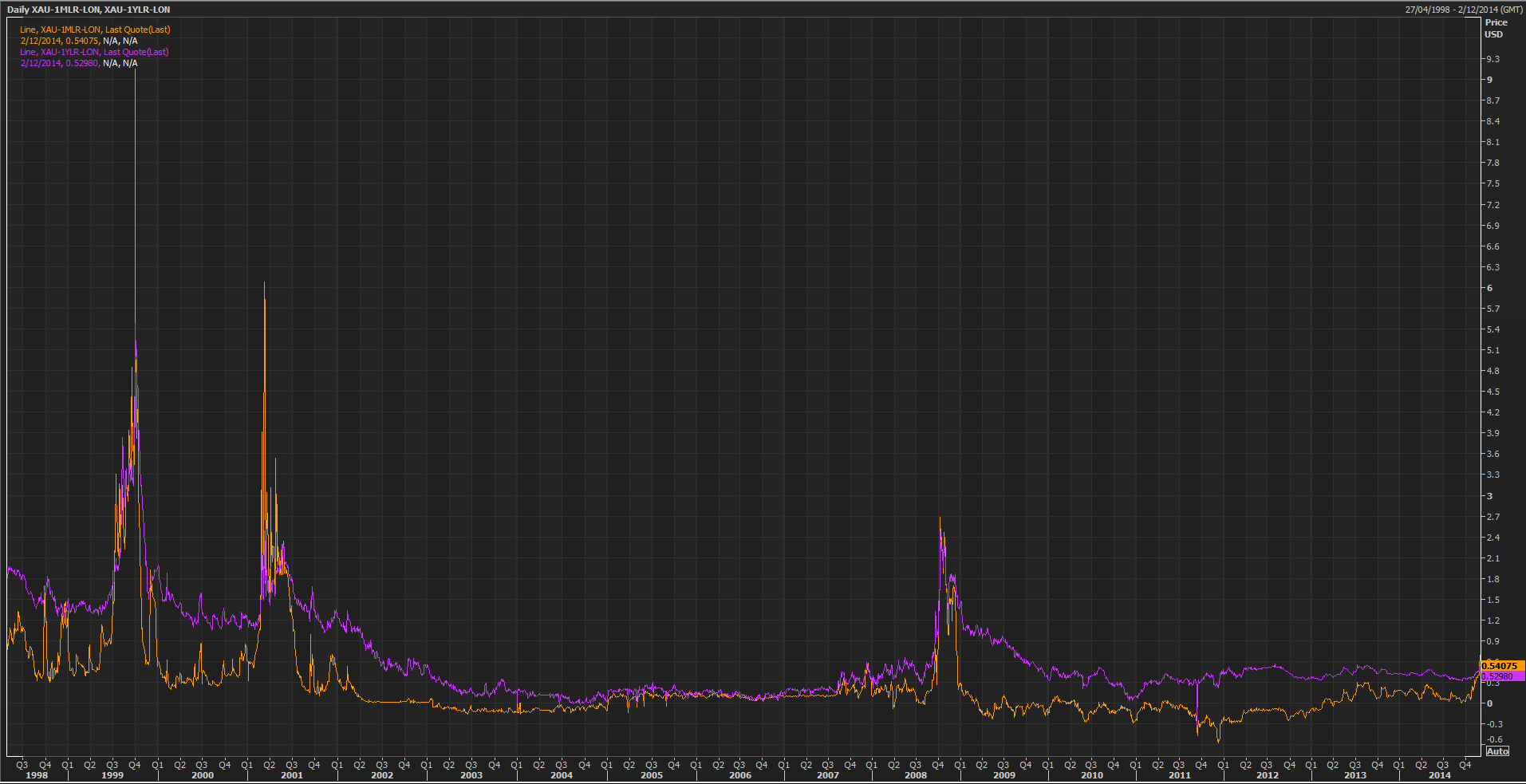
What is interesting is that the gold lease (interest) rate curve has just started to invert, with 1 month rates at 0.54075% while 12 month is at 0.52980%. Such inversions are rare, with the significant occurrences being in 2008, 2001 and 1999.
It is worth noting that during these periods the lease rate spikes lasted for at least 3 months before returning to pre-spike normal lease rates. There is also no correlation with action in the gold price. In 2008 for example, the gold price continued to weaken as lease rates went up during early Q4 2008. In 1999 you can see that the gold price was stable during Q3 1999 all the while lease rate spiked to record highs. So I think it is premature of commentators to spin this high lease rate/negative GOFO as guaranteed indicator of a bottom - history shows that price could weaken further before climbing.
On Monday I gave a number of reasons why we are seeing the action we do. The 2008 experience where the price fell while lease rate were high does suggest shorting. I would note that such shorting action could come from futures markets where speculators see the initial price weakness and then pile in. In such one-sided situations bullion banks will make a market and take the long side and hedge themselves by shorting gold in the OTC spot market. Such shorting activity will result in demand for borrowed gold, hence lease rate rise.
Such a theory means that lease rate spikes (if speculative driven, not liquidity driven) may be indicative of excessive shorting and thus market bottoms. If one saw futures speculative positioning on the short side, bullion banks on the long side and high levels of open interest at the same time as lease rates spiking off recent normal levels, then that could provide strong confirmation of excessive short sentiment.
By the way, Steven Saville has also just blogged on the recent "backwardation", saying much the same as I did on Monday but his post has GOFO and LIBOR charts which show the identical behaviour - worth checking out to see what I was going on about.
22 January 2014
Wealthy Chinese short sellers a source of future demand?
Koos Jansen latest piece on gold leasing and short selling within China is a must read. There seems to be two basic "gold trades" used by wealthy Chinese:
Finance business by Lease and Hedge
1. Lease gold from bank
2. Sell gold on SGE
3. Post 15% of cash from #2 as margin against long gold futures
4. Use remaining cash from #2 to fund your business
5. At end of lease, take delivery of futures and use physical to repay lease
The article says that the effective interest rate on the amount of cash left over from #4 works out at 6.7% compared to around 9% for a conventional loan.
Finance business by Lease and Short Sell
1. Lease gold from bank
2. Sell gold on SGE
3. Use cash to fund your business or other investment
4. At end of lease, buy back gold (which has hopefully fallen) and repay lease
Needless to say, the second method is highly risky and is more a combination of financing your business plus a speculative bet on gold prices. Here are some interesting quotes that give a different insight into the thinking of some wealthy Chinese that is at odds with the common view (narrative) about how Chinese view gold (which is that they are buy and hold investors):
- "these business owners, in the background of gold’s 28% pullback in 2013, remain bearish on gold ... hope to buy back the same amount of gold to repay and get the spread when gold falls further to their targets in 2014"
- "A business owner signed a 3-month gold lease agreement at the end of last year and sold the gold at $1300/oz. He said he would buy back and return the gold when gold fell to $1150/oz in Q1 2014 and pocket the $150/oz difference."
- "some rich people even use the funds through gold lease to invest in high yield real estate trust products to achieve “getting something from nothing”. The spread between the yield on trust products and gold lease rate is risk free in their eyes."
While banks limit gold leasing to those legitimately involved in the gold business who need to finance their physical inventory, it appears that some gold merchants have excess physical stocks. They are therefore willing to lend this out to private investors (who put up cash margin and real estate as collateral). Alternatively, it seems people can create fake gold business to access this market.
Koos' article is similar to a trade identified by FT Alphaville in August, where "Chinese firms have been able to benefit from cheaper US interest rates by using various commodities with high value-to-density ratios, such as gold, copper, nickel and “high-tech” goods, as collateral. The deals were motivated by the fact that borrowing US dollars in this collateralised fashion was cheaper than borrowing in the domestic Chinese market."
See also this GFMS note "our information collection from various trade sources indicated that these Hong Kong export numbers have been highly inflated by growing round tripping between mainland China and Hong Kong whereby local companies used gold to engage in currency and interest rate arbitrage transactions" This would make sense in light of Koos' research that says that the same bar cannot be traded back on to the SGE - maybe a way around this is to export gold out of China and reimport as "new" gold (I have been able to confirm that bars are being exported out of China as part of this trade).
There are a number of implications from this story:
- How much of the gold that we have seen being imported into China is just tied up in these trades?
- Has this Chinese short selling impacted negatively on the gold price?
- When will the unwinding of these short selling deals happen?
- What will be the impact on the gold price when these short selling deals are unwound?
The FT Alphaville article noted that the copper collateral scheme may have raised between $35-40 billion. Gold is a lot more value dense than copper, so realistic to think that the gold collateral trade is of the same or greater size?
I would also note that exports from China to Hong Kong (the round tripping trade) really began to pick up in March 2012, when it was clear that the gold price had peaked. The quotes above indicate that some wealthy Chinese took a bearish view on gold and maybe March was when this short selling trade started to pick up. It is also interesting that this chart of Koos shows big differences developing between SGE withdrawals and all known supply in April 2013, on the price smash. Did the price smash encourage more bearish bets, which would have resulted in gold within China held by industry users being released and sold on the SGE? Maybe Koos can run this chart back a few years so we can see if this gap only developed once gold peaked.

Koos article closes with the observation that "many real estate investment products are facing default risks and on the other, gold lease arbitrage is facing the volatility of gold price. If these 2 risks occur at the same time, this seemingly risk-free arbitrage could be in fact “picking pennies in front of a bulldozer.”"
I am sure that is the majority view of Chinese and this short selling is limited to a few, but China is a big market and this trade could still be significant in terms of the global gold trade. Maybe we have just found another source of potential future demand should these Chinese short sellers come to the view that gold has bottomed.
06 December 2013
Producer/Merchant net long is not necessarily bullish
Gene Arensberg has a good post up on the rare occurrence of COMEX Producer/Merchants category going net long. He sees it as a bullish sign but I would suggest another interpretation which could be more ambivalent.
Gene notes that the producer/merchant "class of traders is dominated by actors who are hedging price risk of their own physical or financial exposure to precious metal, so they are usually more short than long futures" and that it includes "producers and miners, refiners, large jewelers, large bullion merchants". He also observes that for most of the time this group runs at around 160,000 contracts (circa 500 tonnes) short (see the chart below from Gene's site).

Now the interesting this about this is that this group stays pretty much consistently short right through a huge bull run in gold, in pink. Don't you think that is unusual? As the losses mounted, wouldn't they have lightened up? How to account for this behaviour logically?
The key is, as Gene says, that they are hedging their own physical. All of the types mentioned - miners, refiners, jewellers and bullion dealers - have a lot of gold in the working inventories of their businesses. They own this metal (are long) and thus go short to hedge themselves. Their business is about buying gold and transforming it into another more valuable product and then selling it. They are not interested in making money on the gold price itself.
Indeed, if they weren't hedged then as a group holding around 16 million ounces they would have lost around $11 billion dollars in the drop from $1900 to $1200. I'm pretty sure you'll agree that they are unlikely to be making so much profit making coins/jewellery or as coin dealers to wear that sort of loss.
So that is why we see a stable short position for this group, with smaller ups and downs as their sales and inventory fluctuate in response to changes in demand. If demand surges, then their inventory gets run down and they would take short hedges off and the short position would reduce. As they restock inventory, the short position should increase.
We now have a basis on which to explain the 2008/2009 and 2013 divergences from the long run average of 160,000 contracts short.
My explanation for the reduction in shorts from 160,000 to 27,000 in late 2008 is that the financial crisis caused an unprecedented surge in retail demand for gold. The industry was not geared up for that sort of volume so inventories were run down, resulting in a coin premiums surging. As the industry geared up and put on extra shifts etc the producer/merchants were able to restock and hence we see their short position increase again.
Continuing with this inventory based analysis, it suggests the interpretation for the 2013 reduction in short positions to 6,000 long is that the industry is running down its inventory. In 2008/09 the inventory run down was due to a demand surge, but was only temporary. In 2013 the run down has persisted. An explanation for that is that demand and business has dried up - if you aren't selling as much product then you don't need to hold, and can't justify holding, as much working inventory as you used to.
Consider that during 2006/2007 the producer/merchant short position hovered between 50,000 and 100,000 contracts (see this chart, which goes back a bit further than Gene's). The 160,000 average that Gene mentions is from 2009-2010-2011, which is the bull run in gold. An interpretation is that the extra demand during that bull run resulted in the industry needing to run higher inventories, so we see another 60,000+ shorts being added. With the $1900 bust, maybe the industry as a whole got stuck with higher than normal inventories so worked them down to their average of 75,000.
What is interesting is that the rapid reduction from 75,000 short to 6,000 long started after the April 2013 price smash. That event certainly knocked sentiment from the market in the West. It resulted in cash for gold scrap business drying up (therefore less metal tied up in inventories by dealers and scrap merchants) and if you look at US Mint gold coin sales, they drop right off from that point as well, so again coin dealers etc have reduced inventory needs.
To further back up this analysis, consider that US Mint silver coin sales have not reduced like gold and coincidentally the silver producer/merchant short silver position shows no reduction like gold as the silver market is still strong.
So I'd argue that the producer/merchant position is just reflecting the lack of Western interest in physical gold investment (as also demonstrated in gold ETF reductions) rather than them "believe[ing] the path of least resistance is higher for gold." Having said that, I wouldn't say it is necessarily bearish, as Gene is right in that it is a rare signal so could indicate a turning point. I just don't see it as a slam dunk bullish sign either, as this lack of interest in gold is likely to continue until people realise that, no, the economy isn't on the mend and the problems fixed. Until that mainstream narrative changes, we could see speculators testing the gold market to the downside.
Note: I have linked to a number of Nick's Sharelynx charts in this post. Just sign up for the free trial to get access to them, they are invaluable to understanding what is going on in the market, as hopefully this post demonstrates.
10 September 2009
To roll or not to roll, that is the central bank's question
Yesterday I was dismissive of the recall of Hong Kong's gold as significant, but it is another bit of evidence of a shift in central bank attitudes towards gold. Far more significant indicators include (see this MineWeb article):
* China's announcement that it had moved 454 tonnes of gold into its reserves since 2003
* Central Bank Gold Agreement (CBGA) quota being reduced from 500t to 400t a year
* Russia's Prime Minister stating that it should hold 10% of its reserve assets in gold
It points to a renewed appreciation of the role of gold in turbulent times. Recalls of gold like Hong Kong may also indicate a reassessment of counterparty risk. Moves to return gold are eminently sensible, of course: what is the point of a country having its gold out of its immediate physical control if everything goes to hell. That is really the whole point of having gold reserves. In a time of war (not that I'm suggesting that is where we are heading) you ain't going to be able to buy guns or food from another country with your funny paper money.
Some have claimed that repatriation of gold by other central bankers following Hong Kong's lead will translate into higher gold prices. However, this depends on the extent to which that gold is actually sitting in a vault somewhere or has been lent out to bullion banks. If the former, then obviously there is no effect on the price – the gold is just changing location. If the latter, then it could be potentially explosive if Frank Veneroso's estimates of leased gold of between 10,000 and 16,000 tonnes are correct.
I would point out that central banks can't just recall gold mid-lease, they have to wait till it's maturity. Consider also that the leases will have been made over varying terms, from a few months to a few years, and all at different points in time. This means that all of the central bank leases will mature over a number of years. What the term to maturity of this global lease book is, is hard to say. I'll have a stab at most of it being 1 to 2 year leases, but am prepared to stand corrected.
So not all of Mr Veneroso's leases will be recalled immediately, or to be more accurate, declined to be rolled. Plus not all central banks will decline to roll their leases (although that may change depending on how bad things get).
Also, don't fall into the trap of assuming that all of this leased gold has to be bought back from the market to repay the gold loans. This sort of simplistic analysis is based on an ignorant view that “leasing = bad”. The reality is a bit more complex. To explain, I am going to have to be a hypocrite and be simplistic myself. There are three things someone can do with borrowed gold:
1) Manufacture it into jewellery, coins or bars. Sell these for cash. Use cash to buy replacement gold. Hopefully have left over cash = profit. Repeat many times.
2) Sell the gold. Use the cash to build a mine. Extract the gold from the ground. Repay your gold loan. Hopefully have left over gold. Sell this for cash = profit.
3) Sell the gold. Invest the cash to earn interest. Hopefully gold price drops. Use part of your cash to buy gold. Repay your gold loan. Left over cash = profit.
All of the above are ultimately promises to repay gold, but not all of these have the same risk profile. I've ranked them in terms of risk and the first two are materially different to the third. In the first two the gold loan is backed by gold, either in inventory or below the ground.
In the current gold market, one would have to consider the risk of failure low for the coin/bar business – everyone wants the stuff – and I'm sure that central banks, through bullion banks, would not consider these leases high risk and necessitating recall. For jewellery, the increasing gold price equals less sales, so we could expect some business failures, so while these leases are backed by physical it would have to be considered at some risk.
For miners it is a bit more risky. Sure they have it in the ground, but lets not forget Bre-X or Sons of Gwalia. As long as any hedging is modest and loan maturities tied to production, these would also be considered lower risk by central banks.
In the case of the first two it ultimately comes down to the extent that the lease is secured: the first two are not risk free - business ventures do not always turn out as expected. To the extent that they are not secured in some way, central banks would have to be nervous, but not as much as our third category.
In the case of the short sellers, the gold is gone and only cash is left. To the extent that a miner has excessively hedged (did I hear someone say Barrick?), then they are also in this category. The crux of the issue is to what extent have the short sellers put up collateral and more importantly, have the ability to put up more (or the willingness to put up more)?
This collateral issue I will discuss in my next post. My point for the moment is to not get awe struck by the 16,000t figure (or whatever other figure is bandied about) and think it is all going to have to be bought back, and now, and therefore the gold price is going to the moon.
If central bank reassessment of counterparty risk results in requests for leases to be repaid, then it will occur over a number of years as those leases mature. This will manifest itself as a steady stream of short covers, not as a big bang, and be a source of solid "base" demand for gold for a number of years.
* China's announcement that it had moved 454 tonnes of gold into its reserves since 2003
* Central Bank Gold Agreement (CBGA) quota being reduced from 500t to 400t a year
* Russia's Prime Minister stating that it should hold 10% of its reserve assets in gold
It points to a renewed appreciation of the role of gold in turbulent times. Recalls of gold like Hong Kong may also indicate a reassessment of counterparty risk. Moves to return gold are eminently sensible, of course: what is the point of a country having its gold out of its immediate physical control if everything goes to hell. That is really the whole point of having gold reserves. In a time of war (not that I'm suggesting that is where we are heading) you ain't going to be able to buy guns or food from another country with your funny paper money.
Some have claimed that repatriation of gold by other central bankers following Hong Kong's lead will translate into higher gold prices. However, this depends on the extent to which that gold is actually sitting in a vault somewhere or has been lent out to bullion banks. If the former, then obviously there is no effect on the price – the gold is just changing location. If the latter, then it could be potentially explosive if Frank Veneroso's estimates of leased gold of between 10,000 and 16,000 tonnes are correct.
I would point out that central banks can't just recall gold mid-lease, they have to wait till it's maturity. Consider also that the leases will have been made over varying terms, from a few months to a few years, and all at different points in time. This means that all of the central bank leases will mature over a number of years. What the term to maturity of this global lease book is, is hard to say. I'll have a stab at most of it being 1 to 2 year leases, but am prepared to stand corrected.
So not all of Mr Veneroso's leases will be recalled immediately, or to be more accurate, declined to be rolled. Plus not all central banks will decline to roll their leases (although that may change depending on how bad things get).
Also, don't fall into the trap of assuming that all of this leased gold has to be bought back from the market to repay the gold loans. This sort of simplistic analysis is based on an ignorant view that “leasing = bad”. The reality is a bit more complex. To explain, I am going to have to be a hypocrite and be simplistic myself. There are three things someone can do with borrowed gold:
1) Manufacture it into jewellery, coins or bars. Sell these for cash. Use cash to buy replacement gold. Hopefully have left over cash = profit. Repeat many times.
2) Sell the gold. Use the cash to build a mine. Extract the gold from the ground. Repay your gold loan. Hopefully have left over gold. Sell this for cash = profit.
3) Sell the gold. Invest the cash to earn interest. Hopefully gold price drops. Use part of your cash to buy gold. Repay your gold loan. Left over cash = profit.
All of the above are ultimately promises to repay gold, but not all of these have the same risk profile. I've ranked them in terms of risk and the first two are materially different to the third. In the first two the gold loan is backed by gold, either in inventory or below the ground.
In the current gold market, one would have to consider the risk of failure low for the coin/bar business – everyone wants the stuff – and I'm sure that central banks, through bullion banks, would not consider these leases high risk and necessitating recall. For jewellery, the increasing gold price equals less sales, so we could expect some business failures, so while these leases are backed by physical it would have to be considered at some risk.
For miners it is a bit more risky. Sure they have it in the ground, but lets not forget Bre-X or Sons of Gwalia. As long as any hedging is modest and loan maturities tied to production, these would also be considered lower risk by central banks.
In the case of the first two it ultimately comes down to the extent that the lease is secured: the first two are not risk free - business ventures do not always turn out as expected. To the extent that they are not secured in some way, central banks would have to be nervous, but not as much as our third category.
In the case of the short sellers, the gold is gone and only cash is left. To the extent that a miner has excessively hedged (did I hear someone say Barrick?), then they are also in this category. The crux of the issue is to what extent have the short sellers put up collateral and more importantly, have the ability to put up more (or the willingness to put up more)?
This collateral issue I will discuss in my next post. My point for the moment is to not get awe struck by the 16,000t figure (or whatever other figure is bandied about) and think it is all going to have to be bought back, and now, and therefore the gold price is going to the moon.
If central bank reassessment of counterparty risk results in requests for leases to be repaid, then it will occur over a number of years as those leases mature. This will manifest itself as a steady stream of short covers, not as a big bang, and be a source of solid "base" demand for gold for a number of years.
21 August 2008
Producer (de)Hedging
Every quarter www.gfms.co.uk release their Global Hedge Book Analysis. I've been tracking it for a while now as it makes for a very interesting chart (see below). Quarter 2008 report was released last week.
 Seems to be a very strong correlation between the decline in the hedge book (producer de-hedging creates demand for gold) and the rise in the gold price. "What," you say, "the increase in the gold price is not entirely due to the fall in the US dollar and the massive huge demand for US Eagle coins?" Yes, that is correct apprentice goldbug, things are not a simple as some ranters, sorry commentators, would have you believe.
Interesting to note that the de-hedging for the first six months of this year has been 8,000,000 ounces. Sales of US Eagle for the 7 months of this year have been 311,000 ounces. Now don't get offended American coin buyers (and I think it is good you are buying physical) but YOU DON'T MATTER when it comes to making an impact on the gold price.
This chart raises two questions:
1. De-hedging cannot continue forever, it is the lowest it has been since 1987, as it runs down to zero it will remove a source of demand that has been there since 2001.
2. When sentiment changes and producers decide to hedge again, watch out.
Maybe this recent fall has been exacerbated by a miner deciding it is time to lock in these historically high prices? Maybe not. Either way they aint gonna tells anyone beforehand and once the announcement is out, it isn't going to be pretty. About time market commentators started to analyse the statements of the CEOs of producers for hints of their intentions and provide their subscribers with forwarning.
20 August 2008
Subscribe to:
Posts (Atom)